IELTS vs TOEFL: Which English Test Should You Take?
MAREBH • Study Abroad Guide
IELTS vs TOEFL: Which English Test Should You Take?
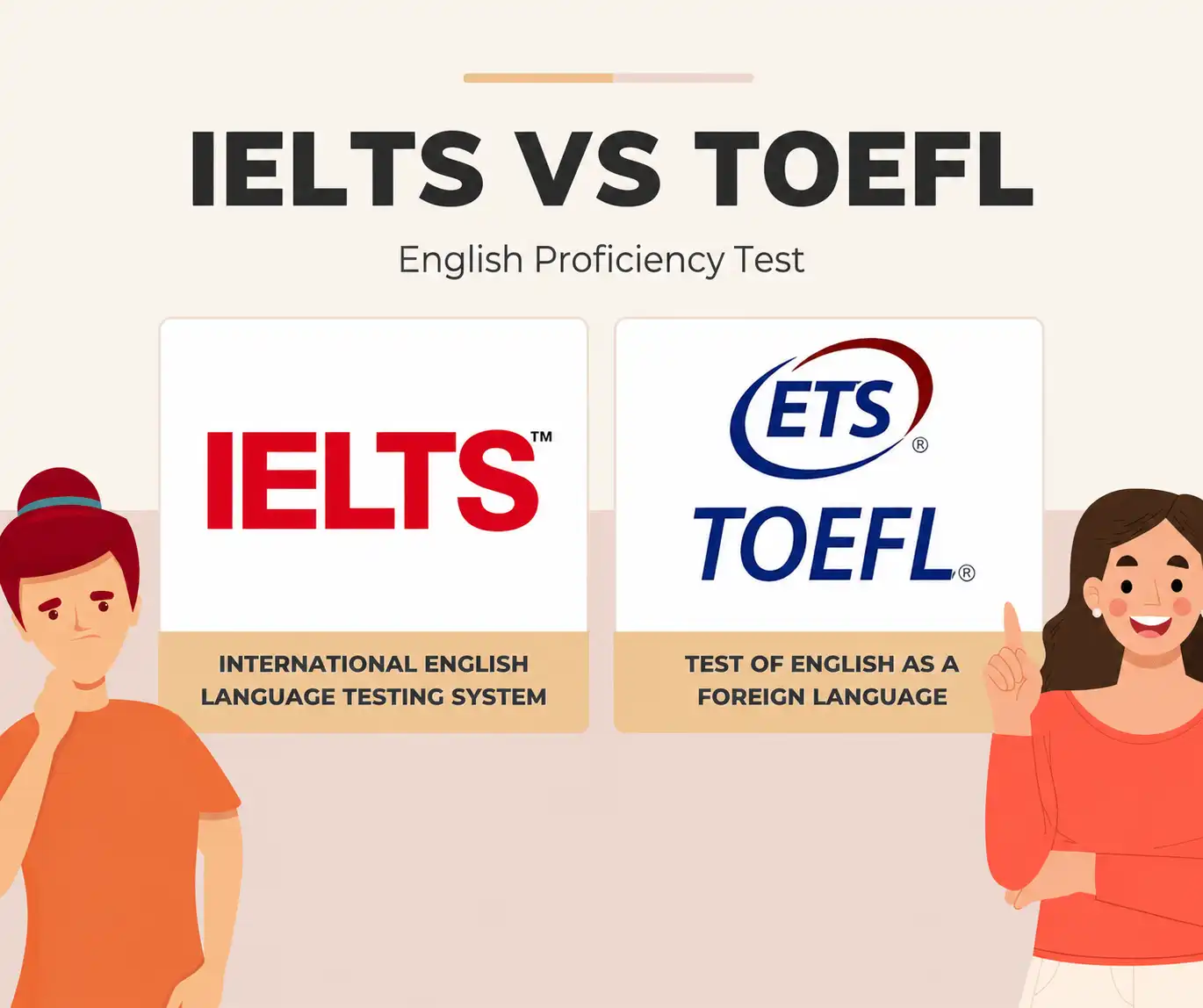
If your target university requires proof of English proficiency, IELTS and TOEFL are almost always the two options on the table. Both are widely accepted, but they differ in format, scoring, and the kind of English skills they reward. Here's how to decide which one fits you best.
IELTS vs TOEFL at a Glance
| Feature | IELTS | TOEFL iBT |
|---|---|---|
| Format | Paper-based or computer-delivered | Fully computer-based (internet-based test) |
| Speaking Test | Face-to-face with a live examiner | Recorded responses via microphone |
| Scoring Scale | Band score 0-9 | Points 0-120 |
| English Accent Focus | British and Australian English | North American English |
| Test Duration | Around 2 hours 45 minutes | Around 2 hours |
| Best Accepted In | UK, UAE, Australia, Canada | USA, and widely accepted elsewhere |
1. Test Format: Paper vs Fully Digital
IELTS still offers a paper-based option in many test centres, alongside a computer-delivered version, so you can choose whichever suits your handwriting speed and comfort level. TOEFL iBT is entirely computer-based, which suits students who type quickly and are comfortable navigating a screen-based test under time pressure.
2. Speaking: Live Examiner vs Recorded Answers
This is often the biggest deciding factor. IELTS Speaking is a face-to-face conversation with a real examiner, which can feel more natural for students who do well in live discussion but more stressful for those who get nervous speaking to a person directly. TOEFL Speaking is recorded into a microphone with no live interaction, which some students find less pressured, while others find it harder without real-time feedback cues.
3. Scoring and What Universities Expect
IELTS uses a band scale from 0 to 9, with most universities asking for an overall band of 6.0 to 7.0 depending on the programme level. TOEFL iBT is scored out of 120, with typical university requirements ranging from 80 to 100. Always check the specific score requirement for your target university and programme rather than assuming a "good score" on one test automatically transfers to the other.
4. Which Test Do Universities Prefer?
Most universities in the UK, UAE, Australia, and Canada accept both tests equally, but IELTS has traditionally been the more common requirement in these regions, while TOEFL is more dominant for universities in the United States. If you already know where you want to study, check that specific university's admissions page to confirm which tests they accept and their minimum score.
5. Preparation Time and Cost
Both tests are similarly priced and require focused preparation, typically 4-8 weeks depending on your starting level. If you're naturally stronger in conversational English, IELTS preparation may come faster; if you're stronger at reading and typing under time pressure, TOEFL prep may suit you better.
Quick Checklist Before You Choose
- Which test does your target university/programme actually require or prefer?
- Are you more comfortable speaking to a live examiner or recording your answers?
- Do you prefer a paper option, or are you confident typing under time pressure?
- Which accent (British/Australian vs North American) are you more used to?
- What score do you need, and how much preparation time do you have?
Not sure which test is right for you? MAREBH offers IELTS training and English test guidance to help you reach the score your university requires.
Talk to an AdvisorLooking for professional study abroad consultants in Uganda? Contact MAREBH today for free counselling. Explore our study destinations or check current scholarship offers.

An ICEF Accredited Agency
PAIEC ACCREDITED